
{{brizy_dc_image_alt imageSrc=

USE CASE:

Project Management

A comprehensive library of out-of-the-box dashboard applications built on a modern open-systems architecture that allows you to easily align your project and make data-driven decisions.

Defense Contract Agency,

Total Savings

$4.65M

Over five year period

Envision Dashboard Apps

Specific applications designed for financial analysts use cases, programs and processes.

Instill accountability and visibility

Deliver real time project financial execution data to keep things on track.

Manage All Your Projects

Even the most complex data structures are effortlessly managed by Proteus Integrator and Envision Data Transformer. Capture all data formats, no matter their origin. Proteus Envision seamlessly adapts to unique schemas and integrates diverse data sources for streamlined project management.
{{brizy_dc_image_alt imageSrc=

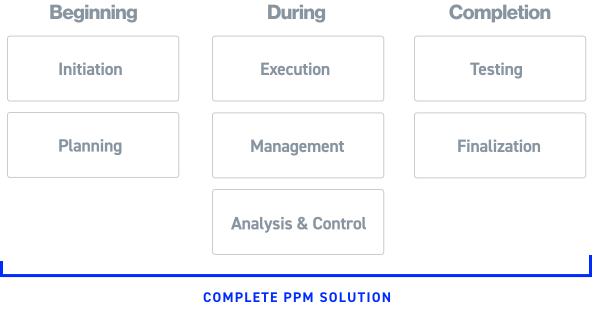
From start to finish

Revolutionize your data visualization and analysis at every project stage with our comprehensive Envision Dashboard App collection.


Empower yourself to unlock the true potential of your data and gain new Business Value Index insight from project initiation to completion.

Comprehensive Project App Library

All project management tools in one place. Now you can utilize data from legacy schemas including the DoD IPMR and IPMDAR to provide a comprehensive EVM, GEAC, and Schedule capability.


Included Applications

IPPM Applications Suite Library

Utilizes data from legacy schemas including the DoD IPMR and IPMDAR to provide a comprehensive EVM, Schedule, and Risk analysis capability.

  • Filter by role:
  • Compliance Management
  • Executive Management
  • Program Management Teams
  • Control Account Manager
  • Risk Analyst
  • Systems Engineer
  • Schedule Analyst
Supplemental EVM and Schedule Data Entry
Enables the utilization of risk data for analysis, visualization, and tracking of contingencies at contract level, including comparing EACs, milestone tracking, and providing executive summaries.
Data Maintenance
Special-purpose application for maintaining and validating data in database for IPPM data.
Loaded IPPM Data
Verifies data that is loaded in the database via Grid views and other visualizations to allow for validation and review.
User and Workspace Logging
User and Workspace Logging Records and visualizes Dashboard Application usage by user and aggregate analytics. Also tracks user transactions on the system for audit and accountability.
EVM Child Drivers
Focused application that shows variance trending for an element, it's children and grand children to easily identify cost and schedule EVM variance drivers.
Integrated Project Management
Fully integrates cost and schedule performance metrics and analysis for EVM, GEAC, IMS, and risk information. Provides
Advanced Integrated Cost and Schedule Metrics
Delivers advanced cost and schedule blended metrics and analysis for predicting future cost and schedule variances, and to validate and reconcile metrics based on differing bases of calculation for the same systems.
IMS Driving Path
Enables schedule analysis by allowing users to filter driving paths to a selected milestone in the IMS and provides a comprehensive selection of best practice analytical information for use on the IMS.
Schedule Analysis with 14-Point Assessment
Visualization of the entire IMS, with features for drill down, schedule tracing, historical trending, performance metrics, reporting and ad hoc visualization and analysis.
Time Phasing Analysis
This integration Dashboard Application visualizes EVM and IMS data to identify inconsistencies and provide insights for proactive project management.
Quick Look IPPM
Delivers focused key cost and schedule performance metrics for a contract. Especially useful for specialized or new personnel, or for initial analysis and validation of early contract deliverables.
Variance Analysis Reporting
Flags variance breaches and allows for Format 5 variance inputs, links to documentation, and full visualization of all aspects of the process.
IPMR Schedule Compare
Highlights schedule changes, tracks undocumented changes, date, duration, logic, code and criticality changes. Useful in tracking undocumented or ad hoc changes that will create erroneous IMS submissions
Time-phasing Compare
Allows the comparison of two time-phased EV data periods, identifying discordant WBS changes and assisting in tracking retroactive changes for consistent planning and execution in cost performance progress calculation and reporting.
PPM Dashboard
Project, Program and Executive Management.
EVM and Schedule Performance
Reports and visualizes level 1 performance data across projects and programs to easily compare performance, providing data regarding differences among project and program performance, and future planning and execution data.

Advanced IPPM (IPMDAR) 

Provides additional functionality to IPPM Repository applications utilizing the greater insight and breadth of data provided by the DoD standard IPMDAR schema.


  • Filter by role:
  • Control Account Manager
  • Financial Analyst
  • Program Management Teams
  • Cost Analyst
  • Schedule Analyst
  • Compliance Management
  • Executive Management
  • Project Analyst
IPMDAR Performance Recalculation and Data Entry
A dashboard application that provides for the recalculation of the data elements needed for the IPMDAR Performance workspace and data entry for contract level auxiliary data including three-point risk.
Baseline Change Control and Review
Flags cost and schedule changes across two periods with drill down by Control Account, Work Package and Task level. Allows for changes tracking and impact analysis.
Program Management Review
Integrates program management metrics, provides flexibility through the IPMDAR schema, and offers customized information based on user roles.
IPMDAR Performance Narrative Report
Facilitates recording and generating an IPMDAR Performance Narrative Report submittal from contract level inputs to WBS/OBS/Control Account breach narratives on impact and corrective actions.
IPMDAR Cost vs. NASA 533/CFSR Financial Analysis
Will generate the NASA 533M and 533Q reports from financial data and earned value IPMDAR data used to reconcile financial execution with cost performance as well as future period planning.

Probabilistic EAC Applications Library

Series of application workspaces that utilize method of moments utilizing statistical modeling of past performance, risk, and SRA results by WBS element to derive a range of estimates at complete/estimates to complete.

  • Filter by role:
  • Cost Analyst
  • Schedule Analyst
  • Program Management Teams
  • Project Analyst
  • Risk Analyst
EAC Probability Setup
Input Dashboard Application for the setup, flagging and coding of the probability function in preparation for the EAC calculation process.
EAC Probability Risk Entry and Review
Allows for the entry and review of risks including probability, impacts and linkages to WBS elements for the probability function. Optional application for Probabilistic EAC functionality.
EAC Probability Calculation
Input/validation workspace app for the probability function.
EAC Probability Analysis
Uses statistical modeling to generate probabilistic EAC and ETC S-Curves for projects, allowing organizations to compare them to the Latest Revised Estimate (LRE) and other estimates for a more comprehensive analysis of project costs.

DCMA DECM Applications Library

Provides functionality for the DCMA EVMS Compliance Metrics system. This functionality leverages all industry and DoD schemas, including the IPMR and IPMDAR files to provide in-depth analysis in support of the DCMA system.

  • Filter by role:
  • Cost Analyst
  • Schedule Analyst
  • Control Account Manager
  • Program Management Teams
  • Compliance Management
  • Executive Management
Recalculation and Loaded Data
Shows the status of imported data for each contract and period end, recalculates the IBR quality checks, provides data maintenance and allows the import of new or corrected data
Test Step Table Manager
Allows the management of the DECM Test Step table and corresponding metadata.
Breakout Reporting
Rolls up DECM trips by entities such as Control Account, Work Package, Time Phasing, Schedule by each Control Account to facilitate reporting and analysis to determine where DECM trips and flags are occurring.
CAM Control Account Pivot
Creates a package of data to assist DCMA or an industry organization with a surveillance and CAM interview environment in one app.
Analysis Data Entry
Provides an input environment for recoding of manual or overridden automated scores, with rationales and other historical analytical functionality.
DECM Details
Integrates the underlying cost and schedule data from which DECM results were derived, showing drill down from contract to control accounts to work packages to tasks to time-phased data and logic links.
DECM Overview
Visualizing the DECM test results for a selected contract and period end, time-phased trending of surveillance history, providing visibility for proactive management for compliance.
Test Record IDs
Provides rapid identification of test steps performed and, of those test step trips with detailed information on the reason for the trip.
DECM Multiple Contracts
Provides a consolidated record of a portfolio of contracts that possess organizational commonalities for macro analysis such as a surveillance review for a program, site and business area.
Format 1 and Format 7
Provides verification of Format 1 or Format 7 data derived from electronically submitted data to compare against hard-copy report submittal.

Schedule Analysis from MS Project Application

Utilizes data from legacy schemas including the DoD IPMR and IPMDAR to provide a comprehensive EVM, Schedule, and Risk analysis capability.

  • Filter BY role:
  • Control Account Manager
  • Schedule Analyst
  • Program Management Teams
  • Project Analyst
  • Compliance Management
Portfolio Schedule Integration and Analysis
Integrates multiple project schedules together for analysis, including ability to set portfolio baseline schedule to track execution against and defining giver/receivers across projects to track variances and margin across handoffs.
Project Analysis
Provides visualization of the entire MS Project schedule, with features for drill down, schedule tracing, historical trending, performance metrics, reporting and ad hoc visualization and analysis.
Schedule Compare
Highlights the changes in the MS Project schedule from one period to another period including date, duration, logic, code and criticality changes. Particularly useful in tracking undocumented or ad hoc changes that will create erroneous IMS submissions for activity and work accomplishment. Also useful in identifying and reconciling retroactive changes.

IBR & Program Data Quality Review Applications

Series of application workspaces that facilitate the preparation for and documentation related to the Integrated Baseline Review (IBR).

  • Filter by role:
  • Compliance Management
  • Program Management Teams
  • Control Account Manager
  • Schedule Analyst
  • Cost Analyst
Data Quality Recalculation and Loaded Data
Comprehensive first step administrative Dashboard Application that shows the status of imported data for each contract and period end, recalculates the IBR quality checks, provides data maintenance, and provides a launcher for Envision Data Transformer for the import of new or corrected data.
Data Quality Test Step Table Manager
Allows the management of the IBR Data Quality checks table and corresponding metadata.
Data Quality Breakout Reporting
IBR data quality trips by entities such as Control Account, Work Package, Time Phasing, Schedule by each Control Account to facilitate reporting and analysis to determine where data quality trips are occurring. Purpose-built to facilitate CAM interviews.
Data Quality Overview
Complete review of data quality test steps to support an IBR.
Data Quality Details
Integrates the underlying cost and schedule data and other artifacts linked to test-step results derived from showing drill down from contract to control accounts to tasks to time-phased data and logic links.
Data Quality Data Entry
Provides an input environment for recoding of manual or overridden automated scores, with rationales and other historical analytical functionality.
IBR Execution – CAM Interview
Manage the CAM interviews with supporting EVM and schedule data to record responses.
IBR Execution – Administration
Establishes the framework to conduct IBRs across projects and programs.
IBR Execution – Planning
establish a time-phased plan and schedule for the delivery of artifacts, the tracking of artifact submission, and the status of questions posed in preparation and closeout of an IBR.

IBR & Program Data Quality Review Applications

Series of application workspaces that facilitate the preparation for and documentation related to the Integrated Baseline Review (IBR).

  • Filter by role:
  • Compliance Management
  • Program Management Teams
  • Control Account Manager
  • Schedule Analyst
  • Cost Analyst
Data Quality Recalculation and Loaded Data
Comprehensive first step administrative Dashboard Application that shows the status of imported data for each contract and period end, recalculates the IBR quality checks, provides data maintenance, and provides a launcher for Envision Data Transformer for the import of new or corrected data.
Data Quality Test Step Table Manager
Allows the management of the IBR Data Quality checks table and corresponding metadata.
Data Quality Breakout Reporting
IBR data quality trips by entities such as Control Account, Work Package, Time Phasing, Schedule by each Control Account to facilitate reporting and analysis to determine where data quality trips are occurring. Purpose-built to facilitate CAM interviews.
Data Quality Overview
Complete review of data quality test steps to support an IBR.
Data Quality Details
Integrates the underlying cost and schedule data and other artifacts linked to test-step results derived from showing drill down from contract to control accounts to tasks to time-phased data and logic links.
Data Quality Data Entry
Provides an input environment for recoding of manual or overridden automated scores, with rationales and other historical analytical functionality.
IBR Execution – CAM Interview
Manage the CAM interviews with supporting EVM and schedule data to record responses.
IBR Execution – Administration
Establishes the framework to conduct IBRs across projects and programs.
IBR Execution – Planning
establish a time-phased plan and schedule for the delivery of artifacts, the tracking of artifact submission, and the status of questions posed in preparation and closeout of an IBR.

Value of cost avoidance in effort and redundancies:

$22.8M

Over five years.

"The implementation of Proteus Envision and Envision Data has revolutionized our data management processes, significantly reducing manual labor and boosting efficiency across our projects."


– Program Analyst, EPFD Program

NASA

Works with these roles:

In-Depth Project Analysis

Access complete analytics with easy access to historical cost data and trend analysis through integrated reports and visualizations.

Detailed Schedule Performance Tracking

Monitor and analyze task completions, schedule predictability, and critical path changes with comprehensive graphs and metrics.

Risk Mitigation and Response Planning

Proteus Envision Dashboard Apps support industry standard metrics. Get accurate and complete analytics with ease access to historical data and trend analysis

Ensure Compliance with Ease

Utilize narratives and detailed reports to track contract modifications, regulatory changes, and compliance metrics effortlessly.

Comprehensive Financial Oversight

Access detailed financial breakdowns and trend analysis, including cost variance and Earned Value metrics, for precise financial management.

Advanced Risk Management

Analyze and predict potential risks with visualizations and graphs, including MR vs. ETC comparisons and best and worst-case scenarios.

Additional Capabilities

Don’t see a feature here? Get in touch to see our full capability list.

Automated data capture & transformation

Automatically process of capturing, transforming, and loading data, resulting in improved productivity and cost savings with Proteus Transformer

Schedule Risk Analysis

Full quantitative Schedule Risks Analysis with robust modeling and reporting capabilities.

Risk Register

Easily import or export data. Then easily score and identify priority risks. Customize fields and setup automation macros to gain new insight.

Local On Premise or in the Cloud

Freedom to choose your preferred deployment option, ensuring optimal accessibility and control.

Risk Mitigation and Response Planning

Streamline risk management: plan, assign, track, and assess mitigation plans. Seamlessly integrate with schedules for optimal effectiveness.

Project Scheduling

Our powerful dashboards predict project issues with blended cost & schedule metrics, plus identify data inconsistencies across systems - all for smarter project control.

IPMDAR Cost vs. NASA 533/CFSR Financial Analysis

Will generate the NASA 533M and 533Q reports from financial data and earned value IPMDAR data used to reconcile financial execution with cost performance as well as future period planning.

With you along the way

We support and involve key leadership players within your organization as it plays crucial role in overcoming barriers based on self-interest and in driving the organization to reach its goals. 

On average

0%

Less then competitors

over a 3 year period.

Total Benefit

0%+

Return on investment

over 3 years

"... we estimate that the SNA solution today is at least 30% less than what the commensurate Deltek suite-based solution would cost."

Program Analyst,

FAA

Ready to Start?

Get in touch with one of our solutions experts for a demo and see how quickly we can unify your data

Learn How To:

Typical Return on Investment over 3 years.:

600%+

Save 66% over 3 years

with our perpetual license model.


Connect with us

Project Management for your whole enterprise

When making decisions about your Data Transformation, the impact extends beyond your department. By establishing a robust technological framework, you enable your entire organization to access, analyze, and trust the data effectively, all while maintaining security and governance protocols.